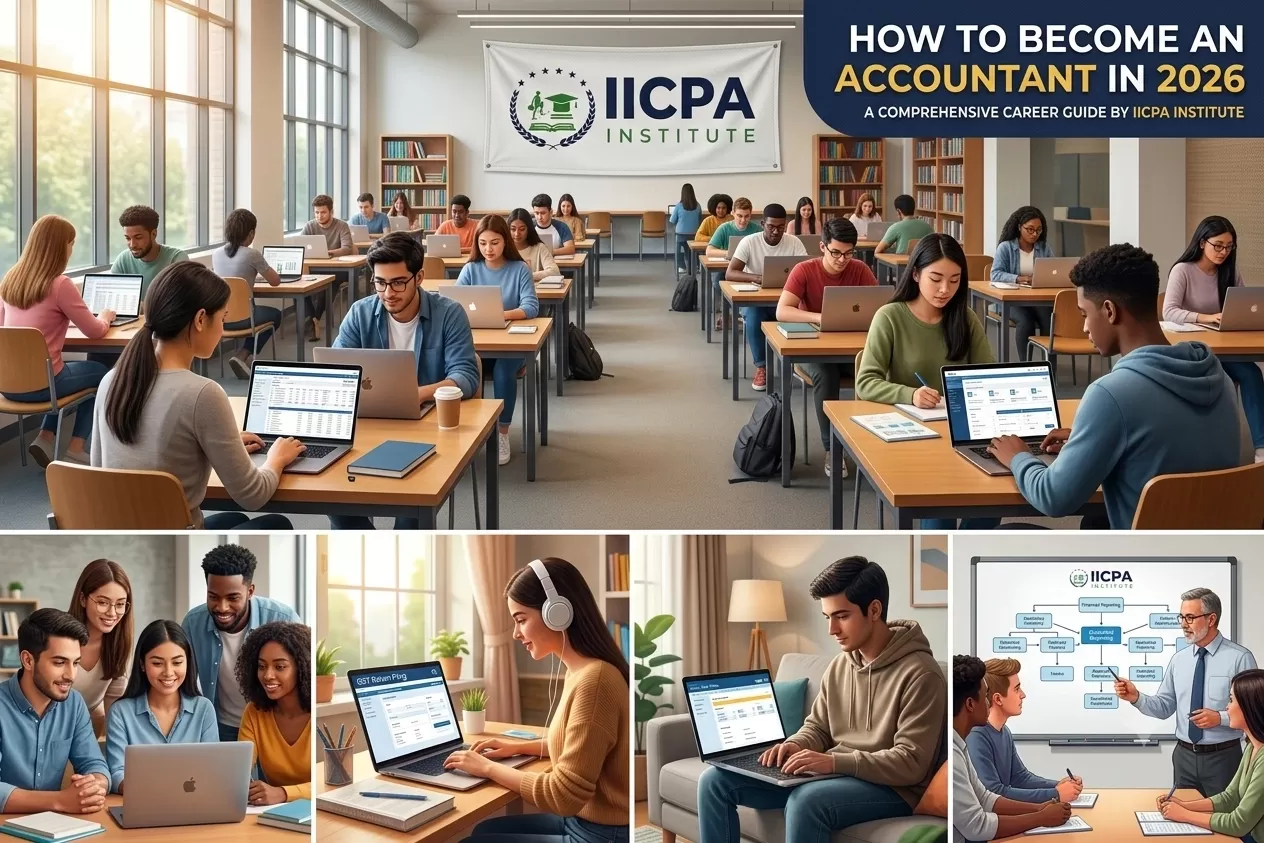
A Practical Roadmap for Career Seekers by IICPA Institute
|
Key Background Context: The Ground Reality of Accounting Jobs in 2026 |
Introduction: Step into the Modern World of Accounting
Let’s talk honestly about building a career in accounting today. Every business, from a local distributor to a massive IT company, runs on numbers. Taxes need to be filed on time, salaries must be processed without errors, and financial reports must be ready for decision-makers. That is why the demand for accountants never really goes down.
However, entering the market in 2026 requires a very different approach than it did five years ago. Just knowing debit and credit rules on paper will not get you hired. You need real practical exposure—how to work on Tally Prime, file a live GST return, calculate payroll tax, and build automated reports in Excel. In this guide, we break down step-by-step how you can become a job-ready accountant, what skills you need, what salary to expect, and how IICPA Institute can help you get there.
Essential Skills You Need to Become an Accountant in 2026
To stand out in interview rooms and secure good job offers, you need a strong mix of software expertise and practical tax compliance skills:
1. Command over Practical Software (Tally Prime & ERP)
Tally Prime remains the backbone of Indian business accounting. You must know how to create vouchers, maintain ledgers, set up cost centers, perform bank reconciliation statements (BRS), and manage multi-branch accounts. Learning software through real transaction entries—rather than just memorizing shortcuts—is crucial.
2. Real-Time GST Compliance & Portal Knowledge
GST isn't just about calculating 18% tax. You need to know how to log into the GST portal, prepare and upload GSTR-1, file GSTR-3B, reconcile Input Tax Credit (ITC) using GSTR-2B, generate E-Way bills, and handle E-Invoicing for corporate clients.
3. Income Tax & TDS / TCS Calculations
Companies expect accountants to manage monthly TDS deductions on vendor payments, compute TCS, file quarterly returns like Form 26Q and Form 24Q, generate Form 16, and assist in Income Tax Return (ITR) filings.
4. Statutory Payroll & Employee Compliance
Payroll handling involves strict legal deadlines. A skilled accountant must calculate gross-to-net salary, process Provident Fund (PF) deductions, calculate ESI contributions, handle Professional Tax (PT), and generate monthly ECR challans on government portals.
5. Advanced MS Excel & Financial Data Handling
Excel is every accountant's daily companion. Mastering XLOOKUP, Pivot Tables, Conditional Formatting, Data Validation, and basic reporting dashboards will double your speed and keep your records organized.
Courses That Get You Hired: Why Practical Training Wins
While a graduate degree in commerce gives you a foundational understanding, a specialized practical certification is what actually opens corporate doors. That’s where IICPA Institute steps in.
At IICPA Institute, the focus is 100% on hands-on practical learning. Instead of lecturing from old textbooks, trainers at IICPA guide you through actual corporate datasets, live tax portal filings, and real-time business accounting scenarios. You learn by doing, which means when you attend an interview, you talk with the confidence of someone who has already done the job.
Salary Expectations & Career Growth in India (2026)
Salary levels in accounting depend heavily on your practical skills, software confidence, and location. Here is a clear overview of average salary packages across different roles in 2026:
|
Job Role |
Average Annual Salary (2026) |
Key Practical Requirement |
|
Junior Accountant / Executive |
₹2.4 LPA – ₹3.6 LPA |
Tally Prime, Vouchers, Basic Excel |
|
GST & Tax Executive |
₹3.5 LPA – ₹5.2 LPA |
GSTR-1, 3B, ITC Match, E-Way Bills |
|
Senior Accountant / Manager |
₹5.5 LPA – ₹8.5 LPA |
Finalization, Audit Support, Direct Tax |
|
Payroll & Compliance Specialist |
₹4.0 LPA – ₹6.5 LPA |
PF/ESI Portal, ECR, TDS Form 24Q |
Career Scope & Future Roadmap
The scope for accountants in India is vast and growing every year. Once you build solid practical skills at IICPA Institute, you aren't limited to working for just one company. You can choose from multiple rewarding career paths:
• Corporate Accounting Roles: Working with mid-to-large private firms managing daily operations, balance sheets, and tax filings.
• CA Firm Practice: Handling client compliance, GST returns, and audit documentation inside Chartered Accountancy practices.
• Independent Tax Practice: Starting your own consultancy to offer GST registration, return filing, and accounting services to local businesses.
• MNC & BPO/KPO Opportunities: Managing global financial records, accounts payable/receivable, and compliance for international companies.
Why Choose IICPA Institute to Start Your Journey?
When picking an institute, you need more than just classroom lectures—you need mentorship from people who know the field inside out. IICPA Institute provides dedicated practical training led by experienced professionals. With updated 2026 modules, flexible batch timings, hands-on portal practice, and full placement assistance, IICPA Institute makes sure you move from student to working professional smoothly.
Conclusion: Take Your First Step Today
Becoming a successful accountant in 2026 comes down to one simple thing: practical ability. If you know how the work is actually done in offices and on tax portals, jobs will follow. Start building your skills today, focus on practical software mastery, and let the IICPA Institute help you turn your career goals into reality.